
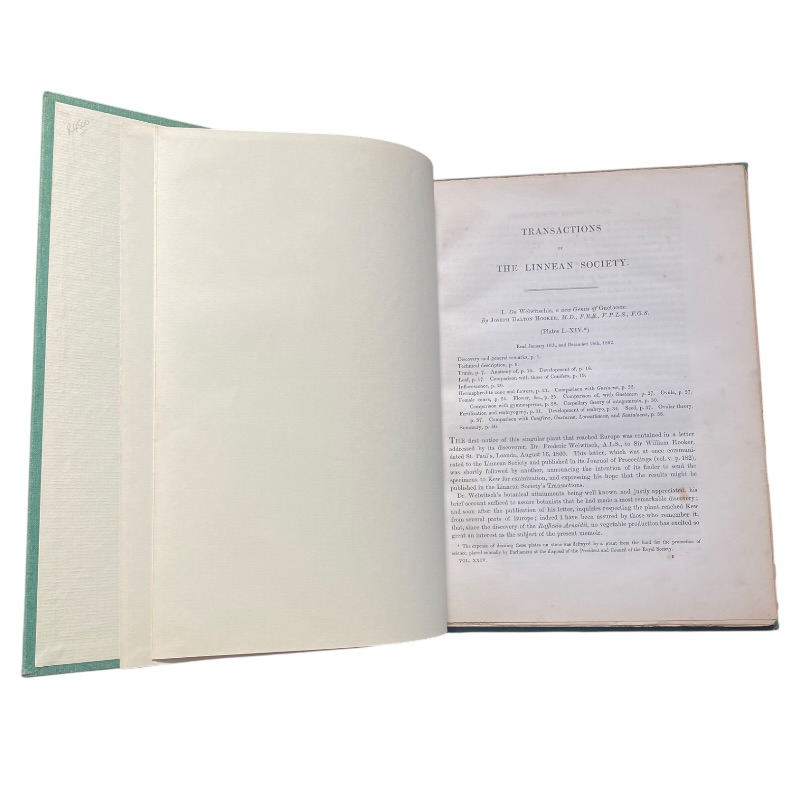
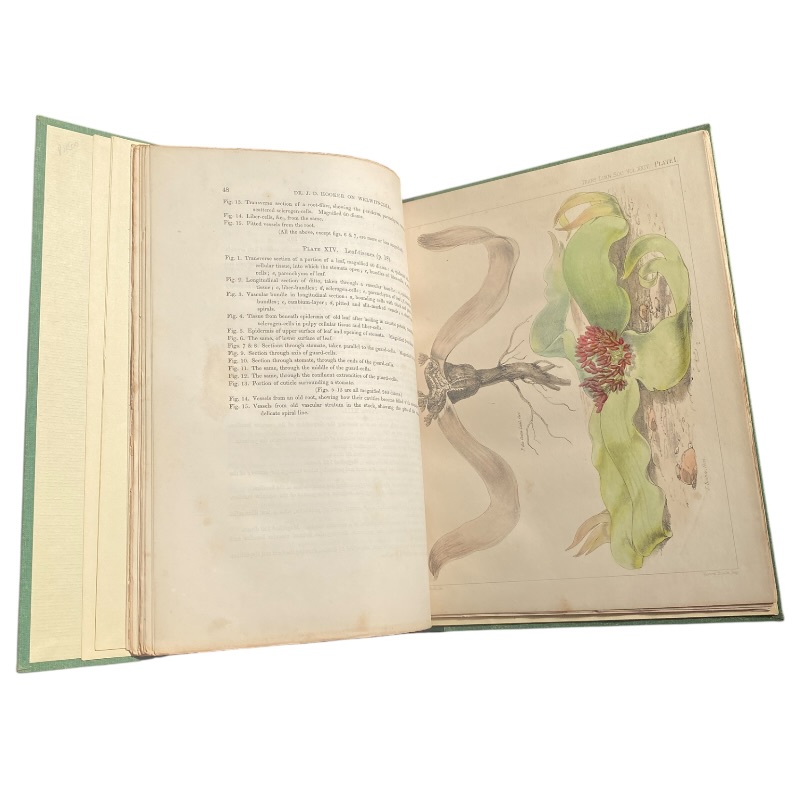
On Welwitschia: A New Genus of Gnetaceae by Joseph Dalton Hooker (1863) is a landmark nineteenth-century botanical publication documenting the scientific discovery and formal classification of one of the most extraordinary plants known to science. Authored by Sir Joseph Dalton Hooker, one of the most influential botanists of the Victorian era and Director of the Royal Botanic Gardens, Kew, this work represents the first authoritative description of Welwitschia mirabilis, a plant endemic to the Namib Desert and unlike any other vascular plant on Earth.
In this seminal 1863 publication, Hooker examines the morphology, reproductive structures, and taxonomic position of Welwitschia, establishing it as a new genus within the Gnetaceae. His analysis draws on specimens collected in south-western Africa and situates the plant within broader botanical debates of the time concerning gymnosperms, evolutionary relationships, and plant geography. The work is written in the formal scientific prose characteristic of mid-nineteenth-century botanical literature and reflects the rigorous observational standards that defined Hooker’s career.
On Welwitschia is significant not only for its subject matter but also for its historical context. Appearing only a few years after the publication of Darwin’s On the Origin of Species, it contributed to contemporary discussions about adaptation, survival in extreme environments, and the deep antiquity of plant lineages. Hooker’s careful documentation helped secure Welwitschia’s place as one of the most studied and iconic plants of southern Africa, often described as a living fossil due to its unique structure and longevity.
As an 1863 scientific publication, this work is foundational to the botanical literature of Africa and remains an essential reference for historians of science, botanists, and collectors of early natural history texts. On Welwitschia: A New Genus of Gnetaceae stands as both a primary scientific document and a testament to Victorian exploration and scholarship, capturing the moment when a botanical anomaly was formally introduced to the scientific world.
Condition: Near Fine – Excellent condition with light fading on spine and minimal wear on boards.