

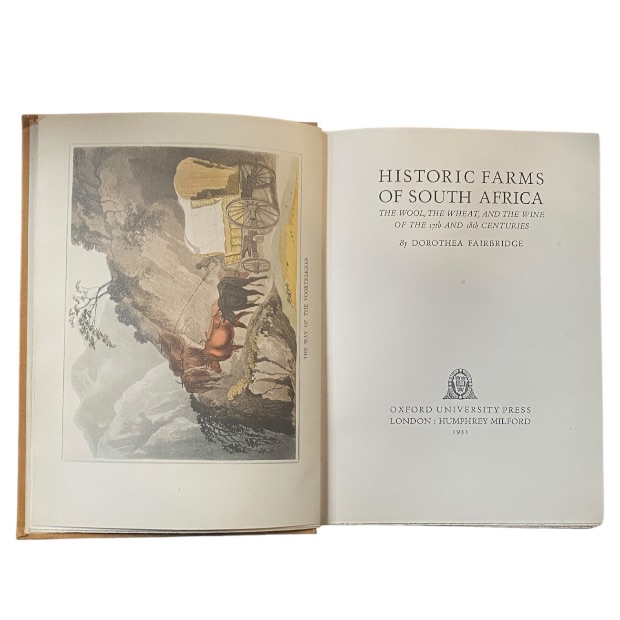
Historic Farms of South Africa by Dorothea Fairbridge was published in 1931 by Oxford University Press and stands as one of the classic works documenting the agricultural and architectural heritage of the early Cape. Fairbridge, known for her deep interest in South Africa’s colonial past, devoted much of her writing to recording the historic homesteads and rural estates that developed during the seventeenth and eighteenth centuries. Her work helped bring wider attention to the cultural value of Cape Dutch architecture and the farming traditions that shaped the region’s early economy.
In Historic Farms of South Africa, Fairbridge explores the origins and development of the Cape’s historic wine, wheat, and wool farms, many of which were established by Dutch settlers and later influenced by French Huguenot immigrants. The book examines the agricultural practices that sustained the colony, while also describing the distinctive homesteads, outbuildings, and landscapes that characterised these early farms. Through historical narrative and architectural observation, Historic Farms illustrates how these rural estates formed the foundation of the Cape’s social and economic life during the colonial period.
Beautifully illustrated and carefully researched, Historic Farms of South Africa combines historical storytelling with a strong appreciation for heritage and landscape. The work remains an important contribution to the documentation of South Africa’s architectural and agricultural past. This 1931 Oxford University Press edition continues to attract collectors of Africana, architectural history, and works devoted to the preservation of the Cape’s historic farms and rural traditions.