Today, Proud Man is widely regarded as an essential text in feminist literature, early dystopian fiction, and gender studies. Its enduring relevance lies in its bold interrogation of identity and its prescient exploration of themes that continue to resonate in contemporary debates around gender and society.
Author
Katharine Burdekin
Publish Date
1993
Cover Type
Hardcover
Condition
Near Fine
Light shelf wear present.
1 in stock
Share This Book
Book Description
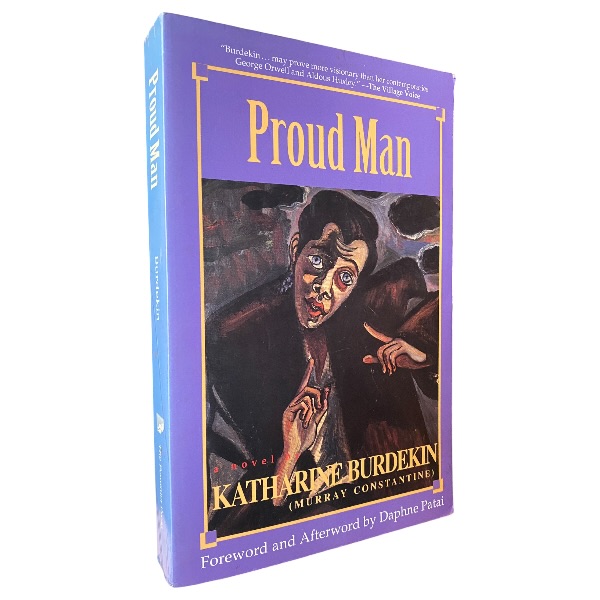
Published in 1993 by The Feminist Press at CUNY, Proud Man by Katharine Burdekin is a reissued edition of one of the most striking and forward-thinking works of early twentieth-century feminist speculative fiction. Originally written under the pseudonym “Murray Constantine” in 1934, the novel was rediscovered and republished decades later for its remarkable challenge to conventional gender norms, identity structures, and social hierarchies. This edition helped reintroduce Burdekin’s work to modern readers as an important precursor to feminist science fiction and gender theory literature.
In Proud Man, Burdekin constructs a thought experiment that examines a society rigidly divided by gender expectations, only to be disrupted by the arrival of an androgynous or non-binary figure who refuses to conform to either male or female roles. Through this central character, the novel interrogates how identity is socially constructed and how power, behaviour, and morality are shaped by gendered assumptions. The narrative unfolds as both philosophical dialogue and social critique, blending speculative fiction with psychological and political exploration.
Katharine Burdekin’s writing in Proud Man is notable for its intellectual ambition and its willingness to confront deeply embedded cultural assumptions. The novel predates much of the later feminist literary movement, yet anticipates many of its key concerns, including gender performativity, social conditioning, and institutional inequality. The Feminist Press edition places the work within a broader historical recovery of overlooked women writers whose contributions reshaped literary and political thought.
Today, Proud Man is widely regarded as an essential text in feminist literature, early dystopian fiction, and gender studies. Its enduring relevance lies in its bold interrogation of identity and its prescient exploration of themes that continue to resonate in contemporary debates around gender and society.
What an amazing shop. And for an indecisive shopper, Robert Cronje’s service selling a book set online that I’d seen in the shop when on holiday and not bought was simply impressive. The book set was wrapped so well it arrived via courier without damage.
Another collector (Fynn Lee) had warned us in advance to prepare a lot of time to browse this massive collection, and he was right! The size of the collection is simply immense. But it's still well organized!
We had a blast hunting for cool books here. We actually spent over three hours here, thoroughly enjoying ourselves as we went through these cool books.
We found so many great books at Midlands. We bought far too many to travel home with, but they were kind enough to ship our books back home for us (overseas).
I highly recommend Midlands Books & Collectibles. Their service was fast and professional with brilliant open and honest communication. Robert Cronjé was an absolute pleasure to deal with and I received my order faster than expected at an excellent rate. Parcel was packed securely and arrived in perfect condition. Very happy new customer and looking forward to buying from Midlands Books soon again.
A real hidden gem for collectors of hard to get books. I was able to get a rare book I was looking for, and for a great price. The people who run this are very nice and was able to get my book shipped very quickly, despite having to have it shipped internationally to here in the states.
Stepping inside this bookstore was a delight! It immediately ranks among the best I've ever experienced. The care and dedication of the owner is palpable. It's the kind of place you could happily get lost in for hours. If you're nearby, this is an absolute must-visit. I can't recommend it enough.
An absolute pleasure to deal with Robert, at Midlands Books and Collectables. My books were extremely well packaged and protected, and shipping was super quick. I received my books 2 days after payment cleared. I will definitely be buying from them again, and highly recommend them.
Patrick
I recently bought a book online from Midlands Books and the experience was great! Robert was very helpful and shipped the book to Spain. The book was a rare find and in pristine conditions! Would recommend 100%!
Absolutely INCREDIBLE treasure trove of the most collectible books, coins and artifacts I’ve seen and absolutely worth the trip out to the Old Mushroom Farm to visit this gem - you could get let in the store for a week and still not get to see everything! Incredible service to match the selection! A must see and worthy of the five stars and more!
Excellent service from Midlands Books. They searched for books and ordered books in for me. I’ll definitely be doing business with them again in future.
We discovered Midlands books and collectibles at the old mushroom farm and at horse shoe bend. You can spend hours browsing the incredible selection of books. The vast array of bird books is definitely worth the visit.
I discovered the most enchanting magical bookshop – a true hidden gem! The moment you step inside, you’re surrounded by shelves that seem to stretch into other worlds, filled with every kind of story imaginable. From secret passageways to cozy reading nooks, this shop has it all, creating an atmosphere that feels like stepping into a fairytale. The staff are as knowledgeable as they are welcoming, always ready to recommend your next great adventure. It’s not just a place to buy books; it’s a doorway to other world with the incredible domed roof of the mushroom farm. A must-visit for any book lover!
Utterly enchanting, in a unique and magical setting (an old mushroom farm tunnel in the beautiful, wooded Midlands Meander). This is hands-down one of the best bookstores I've ever perused (I'm serious about books and work for a major publishing house).
The selection is incredible; I visited from Oxford (England) and was amazed at the very old, rare and precious gems on offer - books that would be snaffled up by auctioneers and collectors too quickly to even set eyes upon in the UK are waiting here at unbelievably good prices.
There is something for every interest and price point; this is both a solid second-hand bookshop as well as collectible store. The owner was so friendly and took time to show my family and I some of the oldest, largest, and most unusual items in the collection. We were dazzled by a poetry book from the Renaissance period; signed first editions of books from authors as diverse as Douglas Adams and Muhammed Ali; antique children's illustrated books and even a hand-coloured illustrated South African bird book. The owner also had an impressive coin / currency collection which was fascinating to view.
If the literature or objets d'art were not enough, there was also a delightfully cosy dog (pictured) - irresistible! I walked away a very happy customer and will go out my way to visit again when I'm next in South Africa.
Wow! Amazing diversity of previously owned and collectible books. I enjoyed the section on books about birds and birding - several shelves worth - just on this topic - including many rare and classic texts.