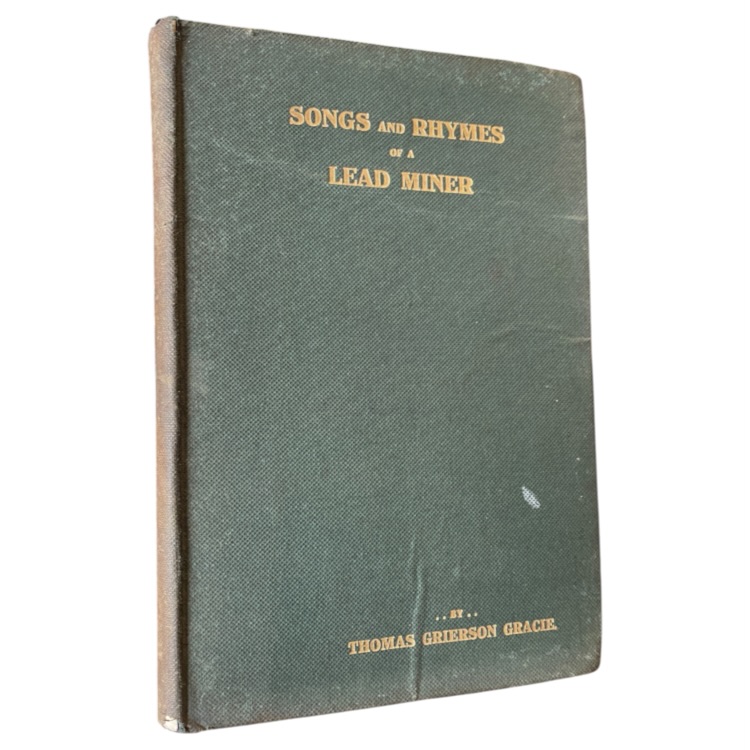
Songs and Rhymes of a Lead Miner by Thomas Grierson Gracie is an uncommon 1921 collection of Scottish working-class poetry, songs and reminiscences written by a man whose life was intimately connected with the lead-mining community of Wanlockhead, Dumfriesshire. Gracie was born at Wanlockhead in 1861 and began working as a lead washer at only thirteen years of age before eventually becoming a qualified lead miner. He also worked for several years in Scotland’s coal mines and was an accomplished amateur musician, particularly associated with the violin.
Published by the Courier and Herald Press of Dumfries, Songs and Rhymes of a Lead Miner provides an unusually personal literary record of Scottish mining and village life during the late nineteenth and early twentieth centuries. Songs and Rhymes of a Lead Miner is written partly in Scots dialect, the poems range across mining, rural landscapes, local personalities, courtship, music, humour, community events and remembrance. Several pieces also reflect the experience and patriotic sentiment of the First World War. Among the mining-related works are The Miner, Level No. 6, Emergency Pump, Level No. 4 and Pony Driver’s Lament.
Of particular interest in this copy is the substantial handwritten presentation inscription on the front endpaper, dated 25th March 1940, apparently presented at Boksburg, Transvaal, giving Songs and Rhymes of a Lead Miner an additional South African provenance and social-history dimension.
Songs and Rhymes of a Lead Miner is an appealing and scarce piece for collectors of Scottish poetry, mining history, labour history, Scots dialect literature and unusual working-class writing.
Condition – Fair
Original green cloth hardcover with gilt lettering to the front board. Considerable age-related wear is present, particularly to the spine and extremities. The cloth is faded and rubbed, with fraying and loss at the spine ends and corners. There is a small area of surface loss/abrasion to the front board. The spine covering shows substantial fading and wear. Page edges are toned, with scattered foxing and age-related spotting internally. A lengthy handwritten presentation inscription dated 25 March 1940 occupies the front endpaper. Despite the external wear, this remains an attractive and historically interesting surviving copy of an uncommon 1921 publication.