
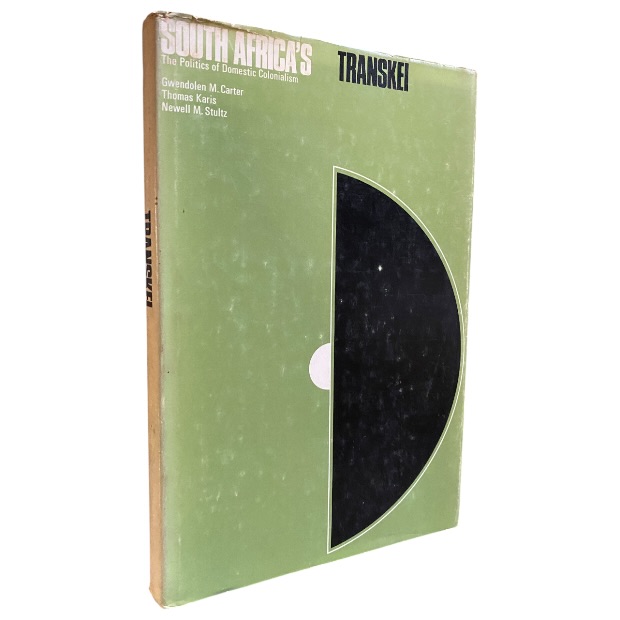
South Africa’s Transkei by Gwendolen M. Carter was published in 1967 by Heinemann and remains an important scholarly examination of apartheid-era policy and African political development. Written at a time when the South African government was consolidating its Bantustan strategy, this volume provides a rigorous political analysis of the Transkei, the first territory designated for nominal “self-government” under apartheid. Carter, a distinguished authority on African politics, collaborated with fellow researchers to produce a work grounded in field research, documentary evidence, and contemporary political observation.
In South Africa’s Transkei, the authors investigate the ideological and administrative foundations of what they term “domestic colonialism,” analysing how the apartheid state sought to reconfigure citizenship, territorial authority, and ethnic identity. The book traces the historical background of the Transkei, the structure of its legislative assembly, the role of traditional authorities, and the broader implications of the homeland system for South Africa’s Black majority. Particular attention is given to the ways in which political power was constrained, reshaped, and instrumentalised within the framework of separate development.
As both a contemporary account and a critical academic study, South Africa’s Transkei offers valuable insight into the mechanics of apartheid governance during the 1960s. For readers interested in South African political history, African studies, or the theory of internal colonialism, this 1967 Heinemann edition stands as a significant and thought-provoking contribution to the literature on state power and resistance in twentieth-century Africa.