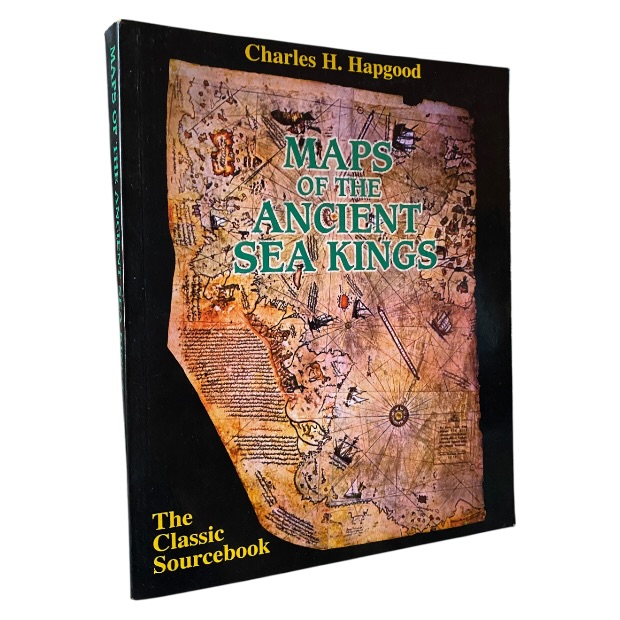

Maps of the Ancient Sea Kings: Evidence of Advanced Civilisation in the Ice Age by Charles H. Hapgood (Souvenir Press, 2001) is a controversial and influential work that challenges conventional interpretations of early human history and ancient cartography. Originally developed from Hapgood’s pioneering research of the mid-twentieth century, this 2001 Souvenir Press edition reintroduces his ideas to a modern readership, preserving one of the most debated alternative history texts ever published.
In Maps of the Ancient Sea Kings, Hapgood examines a selection of early maps, most famously the Piri Reis map, arguing that their accuracy cannot be explained by the geographical knowledge traditionally attributed to the periods in which they surfaced. He proposes that these maps were compiled from much older source material created by a highly advanced civilisation that existed during the Ice Age and possessed sophisticated surveying and navigational capabilities. According to Hapgood, this civilisation may have been destroyed or displaced by catastrophic climatic events at the end of the last glacial period, leaving only fragmented traces of its knowledge behind.
Maps of the Ancient Sea Kings blends cartographic analysis with geological and historical evidence, focusing on coastline accuracy, map projections, and apparent representations of ice-free Antarctica. Hapgood’s approach is methodical and analytical, presenting his arguments with detailed reasoning rather than sensationalism. Although his conclusions remain outside mainstream academic consensus, the work is notable for its intellectual seriousness and the questions it raises about the transmission of ancient knowledge.
The book is also well known for its association with Albert Einstein, who supported Hapgood’s willingness to challenge orthodox thinking and contributed a foreword to earlier editions. This connection has helped cement the book’s place in discussions about lost civilisations and prehistoric science.
As a 2001 Souvenir Press publication, this edition remains highly sought after by readers interested in alternative history, ancient maps, and speculative archaeology. It stands as a thought-provoking and enduring exploration of humanity’s deep past and the possibility that advanced knowledge may have existed far earlier than traditionally believed.