
The Parts of a Book Explained Understanding Book Anatomy, Binding, and Structure
Books may look simple from the outside, but every traditionally bound book is made up of many carefully constructed parts. Understanding the anatomy of a book helps readers, collectors, and buyers accurately assess book condition, binding quality, and long-term durability.
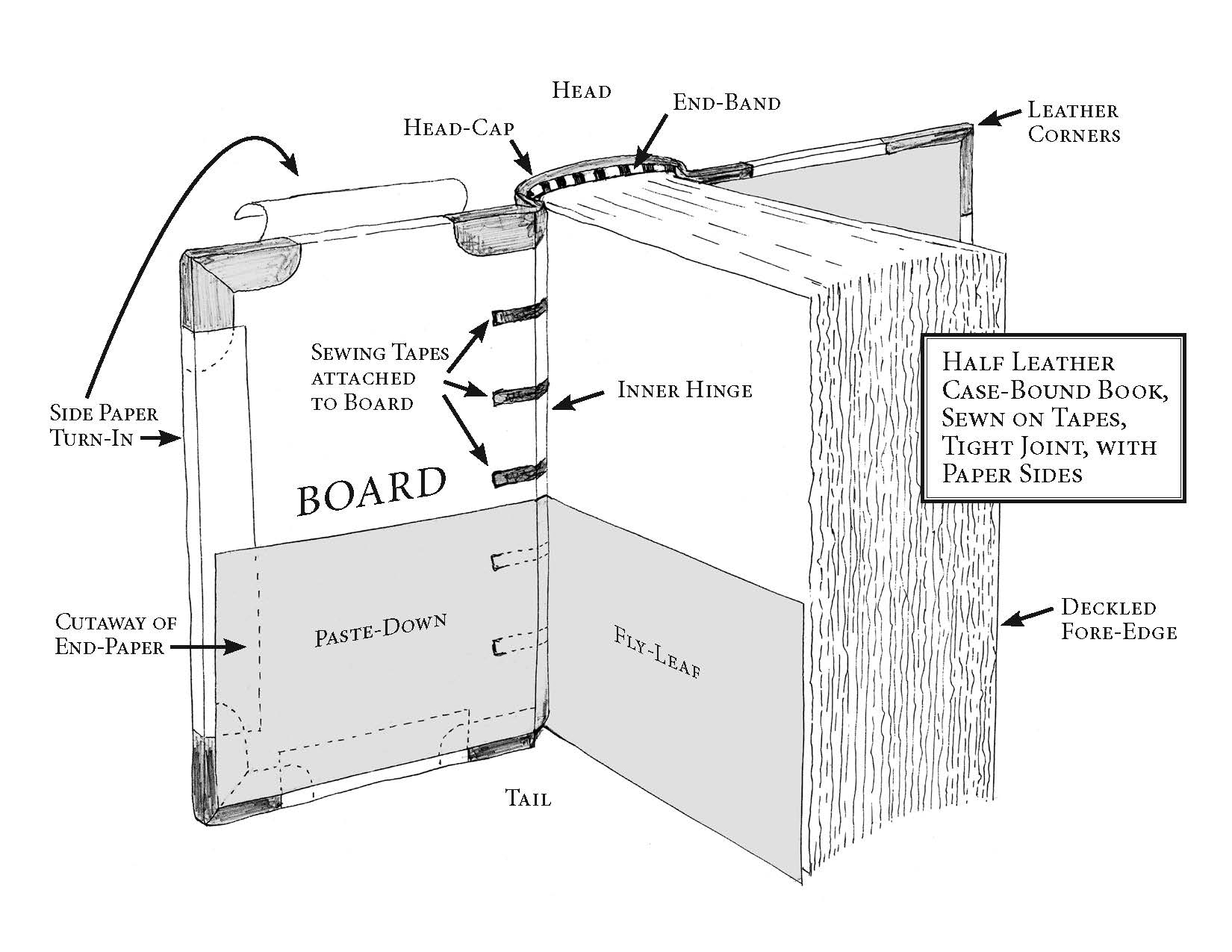
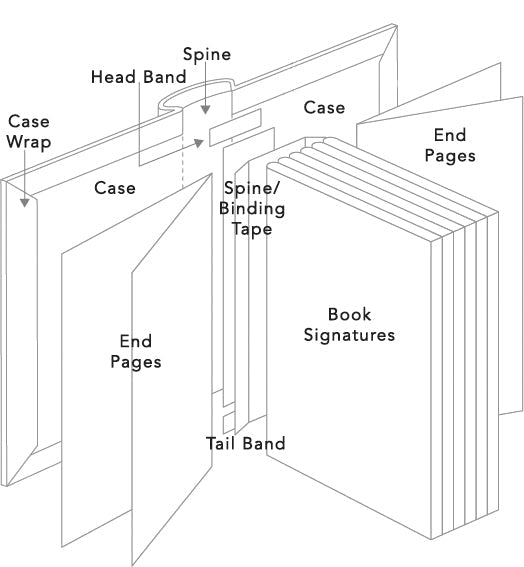
Using the diagrams shown above, this guide explains the key parts of a book, focusing on bookbinding terminology commonly used when describing second-hand books, collectible books, and antiquarian bindings.
The Case, Covers, and Boards
In a case-bound book (hardcover), the outer structure is known as the case.
The case consists of:
Front and back boards – rigid boards that give the book its strength
Case wrap / cover material – cloth, paper, or leather covering the boards
Leather corners (in some bindings) – added protection on higher-end or older books
The edges and corners of the boards are often the first areas to show wear and are closely examined when grading book condition.
The Spine and Spine Structure
The spine is the backbone of the book and one of the most critical structural elements.
Visible spine features include:
Head – the top of the spine
Tail – the bottom of the spine
Head-cap – the folded edge of the spine material at the top
Spine covering – leather, cloth, or paper
Tight joint – where the spine covering meets the boards
Damage to the spine, head, tail, or joints can significantly affect a book’s usability and value.
Headbands and Tail Bands
Located at the head and tail of the spine, headbands and tail bands were originally functional, reinforcing the binding. In modern books they are often decorative, but their presence and condition still matter when describing book bindings accurately.
The Textblock and Book Signatures
The textblock is the main body of the book — all the pages bound together.
The diagrams show:
Book signatures – folded groups of pages sewn together
Sewing tapes – cloth or cord tapes the signatures are sewn onto
Spine / binding tape – helping secure the textblock to the case
A book sewn on tapes is generally stronger and more desirable than a purely glued binding, especially in collectible and older books.
Pages, Leaves, Recto and Verso
In book terminology:
A leaf is a single sheet of paper
Each leaf has two sides:
Recto – the front or right-hand page
Verso – the back or left-hand page
Understanding this distinction is important when collating books and checking for missing or damaged pages.
Endpapers, Flyleaves, and Hinges
The endpapers connect the textblock to the case and play a crucial structural role.
The diagrams clearly show:
Paste-down endpaper – glued to the inside board
Flyleaf (free endpaper) – the loose page before the text
Inner hinge – the flexible joint allowing the book to open
Endpapers are often the first place structural issues appear, such as cracking, splitting, or looseness.
The Gutter and Fore-Edge
The gutter is the inner margin where pages meet at the spine. Adequate gutter space ensures:
Text remains readable
Pages turn freely
The binding is not overstressed
The fore-edge is the outer edge of the textblock opposite the spine. As shown in the diagrams, some books have:
Deckled fore-edges
Gilt or coloured edges
These features are often noted in condition descriptions.
Why This Terminology Matters
Understanding book anatomy, bookbinding terms, and the parts of a book allows buyers and sellers to:
Accurately describe book condition
Identify structural problems
Understand binding quality
Appreciate traditional bookbinding craftsmanship
At Midlands Books, we actively use this exact terminology in our condition descriptions on www.midlandsbooks.com. This ensures clarity, transparency, and consistency, especially when dealing with second-hand books, collectible editions, and older bindings.
Final Thoughts
Every book tells two stories — one through its words, and another through its binding, structure, and physical condition.
Once you understand the parts shown in these diagrams — from the spine and boards to the textblock, signatures, endpapers, and gutter — you’ll never look at a book the same way again.
For carefully described second-hand books in South Africa, collectible books, and expert condition grading, visit www.midlandsbooks.com.