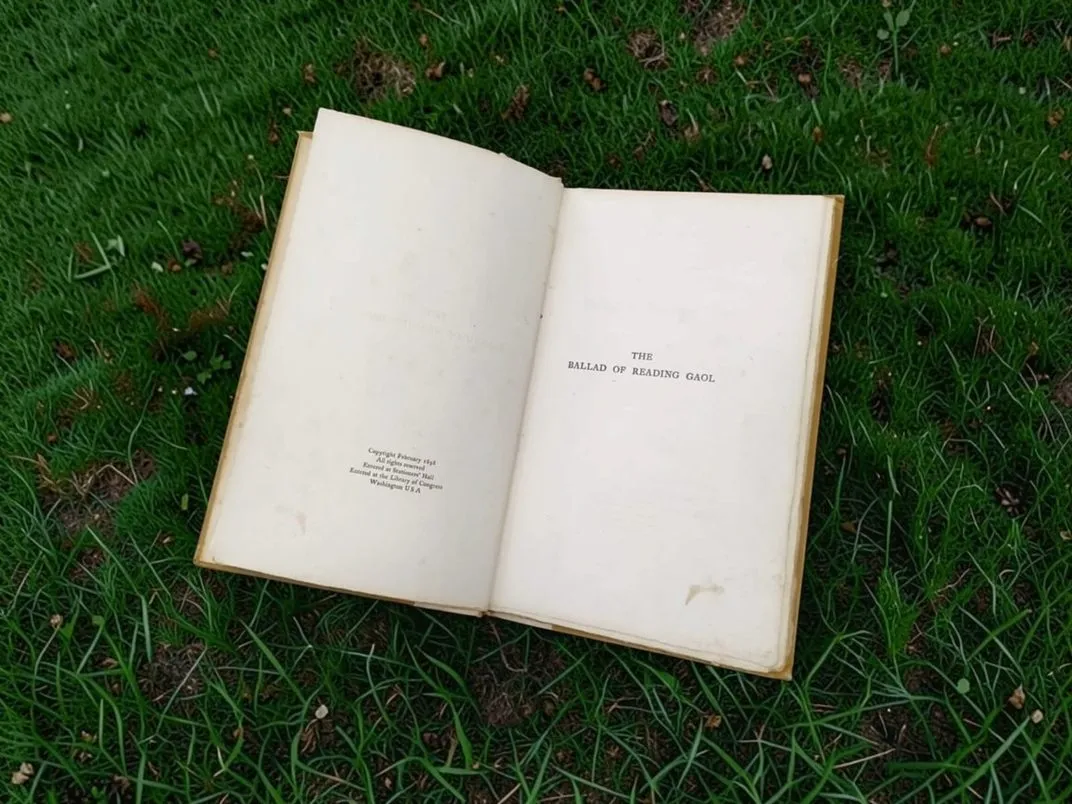
Some books earn a place on a collector’s shelf through scarcity alone. This one earns it through its story as much as its rarity. It is a slim volume of poetry, printed in London in 1898, and its title page names the author only as “C.3.3.” On that same title page, in faded brown ink, a previous owner has written a date: 16.11.98. That is 128 years ago, to the day, as this book becomes our Book of the Month on Monday 16 November 2026.
Here is the full story of the book, the edition, and how to recognise an early copy of Oscar Wilde’s most famous poem.
“C.3.3.” was Oscar Wilde. The letters and numbers were his cell designation at Reading Gaol: Block C, landing 3, cell 3. Wilde served two years there with hard labour, and after his release in 1897 he lived in exile on the Continent. The Ballad of Reading Gaol was the last major work he published before his death in 1900.
It first appeared on 13 February 1898, published in London by Leonard Smithers of the Royal Arcade. Wilde’s name was nowhere on it. He published it anonymously as C.3.3., a quiet acknowledgement of where the poem was born. The dedication leaf reads “In Memoriam C.T.W., Sometime Trooper of the Royal Horse Guards, Obiit H.M. Prison, Reading, Berkshire, July 7th, 1896.” C.T.W. was Charles Thomas Wooldridge, a guardsman hanged at Reading in 1896 for the murder of his wife. His execution during Wilde’s imprisonment is what the poem is built around.
The poem sold quickly. The first printing went in about a week, and Smithers kept the presses running, issuing edition after edition through 1898. The copy we have is the fifth edition, so stated on the leaf facing the title page, and still printed in 1898, the year of first publication.
What makes the early printings interesting to collectors is the anonymity. Through these 1898 editions the author is given only as C.3.3. Wilde’s real name did not appear on the title page of the early Smithers printings at all; it was not until later, around the seventh printing in 1899, that his authorship moved into the open. So this fifth edition still carries only “C.3.3.” Oscar Wilde’s name appears nowhere in the book. It is a copy from the year of first publication, in its original anonymous state.
If the difference between an edition, a printing and a true first edition is new to you, our guide to telling a first edition from a later printing walks through exactly what to look for, and our book grading guide explains the condition terms dealers use.
It is a handsome period copy, still in its original publisher’s binding: a quarter cream vellum spine over mustard cloth boards, with the title lettered in gilt on the spine as issued. It stands about 23 cm tall and 15 cm wide, with the poem running to 31 numbered pages on thick, good quality paper with generous margins.
The edges are untrimmed, with rough deckle edges on the fore-edge and lower edge. This is how the book left the bindery in 1898, not damage. Untrimmed edges are a feature collectors look for, and they give this slim volume a much older, hand-made feel.
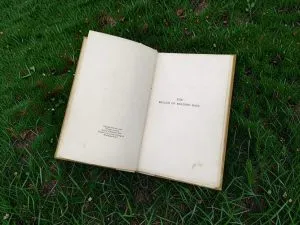
The title page reads “The Ballad of Reading Gaol By C.3.3.”, with the Leonard Smithers imprint and the date in roman numerals, MDCCCXCVIII. The copyright notice reads “Copyright February 1898, All rights reserved, Entered at Stationers’ Hall, Entered at the Library of Congress, Washington USA.”
We grade it Very Good, and we describe it honestly. The binding is firm and the book is complete and sound after 128 years. Against that, the gilt on the spine is slightly faded, there is some light scuffing to the boards and vellum, all four corners are gently bumped from handling, the endpapers are evenly toned, and there is foxing to the first few leaves and scattered lightly through the text. For a book of this age in its original binding, it has held up very well.
On the title page, in ink, is a contemporary ownership inscription: “T. Lynedoch Graham” (the front free endpaper carries the same owner’s name as “T.L. Graham”), with the date 16.11.98 underlined. That places the book in a private owner’s hands on 16 November 1898, only months after it was printed.
Which is why it is our Book of the Month on 16 November. The date in the book and the date on the shelf line up exactly, 128 years apart. We know nothing more about T. Lynedoch Graham, but the inscription does something a pristine copy cannot: it proves the book was bought and read within months of publication, and it has since travelled as far as a Johannesburg collection, where it came to us. A dated inscription like this adds provenance and story far more than it adds to the price, and for many collectors that is the best part.
If you are looking at a copy and want to know whether it is an early one, these are the markers to check:
A copy printed in 1898, in its original binding, still credited to C.3.3., is the kind of early Wilde that collectors of 1890s literature and Victorian poetry look for.
Early Oscar Wilde editions are sought after, and prices reflect condition, binding and edition. This copy is priced at R5,995, based on comparable copies offered elsewhere: an 1898 printing, from the year of first publication, in its original publisher’s binding, graded Very Good, with a dated contemporary inscription. You can see the full description and photographs on the product page for The Ballad of Reading Gaol. If you enjoy the “what is it worth” question, our piece on the most valuable South African book ever sold is a good read.
C.3.3. was Oscar Wilde’s cell number at Reading Gaol (Block C, landing 3, cell 3). After his imprisonment and release, Wilde published the poem anonymously under that designation in 1898. His name did not appear on the early Smithers title pages; his authorship only moved into the open with later printings in 1899.
No. The first edition was the first printing of February 1898. The fifth edition is a later 1898 printing, clearly stated as “Fifth Edition” on the leaf facing the title page. It is still a copy from the year of first publication and still carries only the C.3.3. attribution, which is what makes early 1898 printings collectable.
No. Like the other early 1898 printings, the author is given only as C.3.3. Oscar Wilde’s name appears nowhere in the book.
They are not damage. The book was issued with its edges left untrimmed, so the fore-edge and lower edge are roughly deckled as they came from the bindery. Untrimmed edges are original to the book and are something collectors value.
It depends on the edition, the binding and the condition. Early 1898 Smithers printings in the original binding are the desirable ones. This copy, an 1898 fifth edition in Very Good condition with a dated contemporary inscription, is priced at R5,995.
Yes. It is available on our website while in stock, and Midlands Books ships worldwide, carefully wrapped and packed. See the product page for details, or get in touch if you have a question.
While it is in stock you can view and buy The Ballad of Reading Gaol by Oscar Wilde (C.3.3.) directly. Books like this are one of a kind, so if it has already sold by the time you read this, contact us and we will add the title to your want list and let you know when another comes in. You can also browse more of our rare and collectible books.
ZAR |
R |
 |
USD |
$ |
 |
EUR |
€ |
 |
GBP |
£ |
 |
|
ZAR
|
USD
|
EUR
|
GBP
|
See new arrivals first
Join our list for first dibs on rare and collectable finds