If you have ever squinted at an old book and seen what looks like “fufpected” instead of “suspected”, you are not misreading it, and the printer did not slip up. That tall letter is not an f at all. It is the long s (ſ), an old form of the letter s that English printers used for centuries. Spotting it is one of the quickest ways to tell you are holding a genuinely old book.
The long s (ſ) is simply an old way of writing a lowercase s. For hundreds of years it was the normal way to set the letter in print, so it turns up constantly in books from the 1500s through to the late 1700s. It is not decorative, and it is not a mistake. It is just how s used to look.
The trick is telling it apart from an f. Look closely: an f has a full crossbar that cuts straight through the stem, left to right. The long s has, at most, a small nub on the left of the stem and no bar crossing all the way through. Once you have seen the difference, you cannot unsee it.
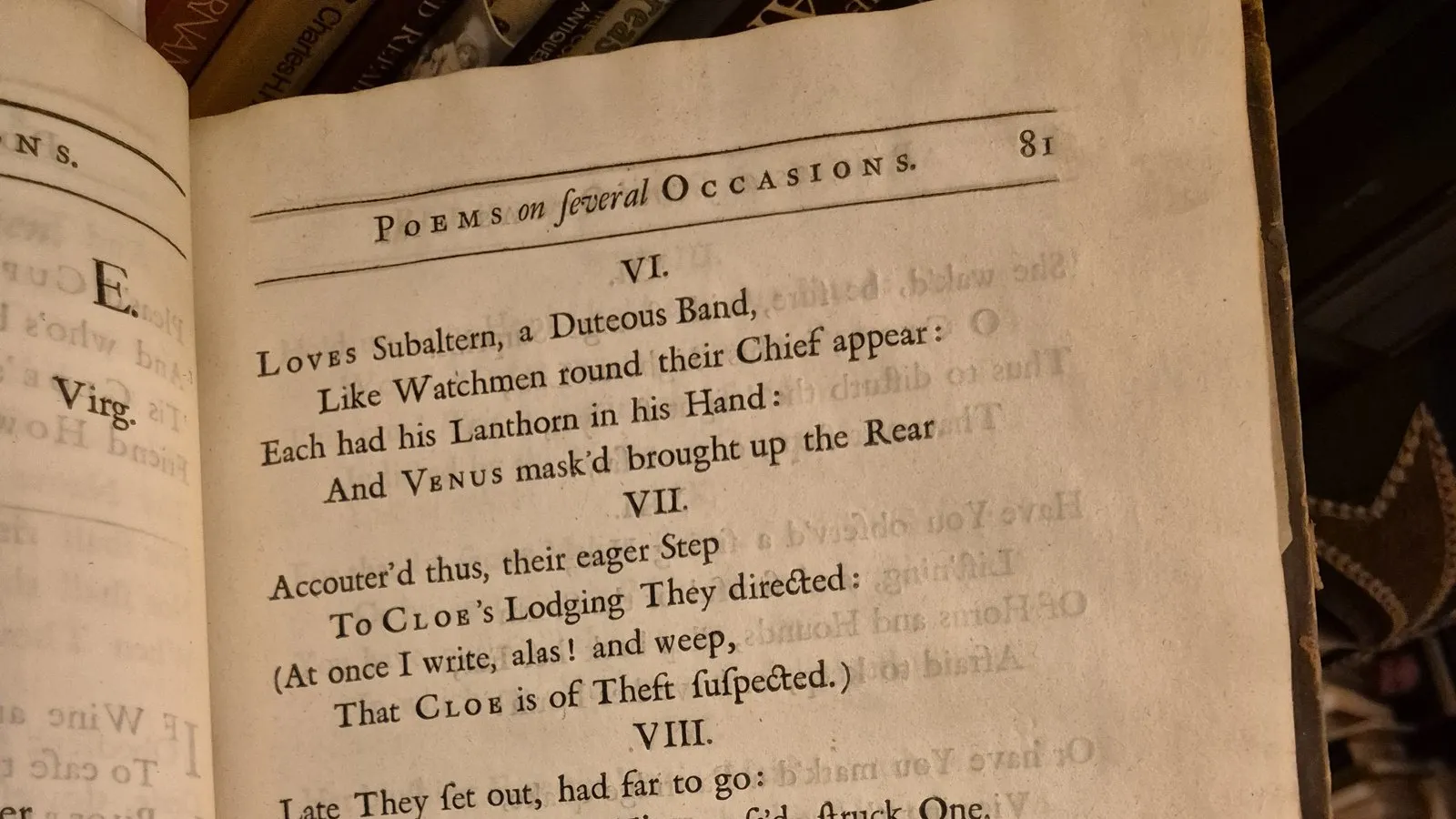
Old books did not use the long s everywhere. Printers followed rules: the short, round s we use today appeared at the end of a word, while the long s was used at the start or in the middle. So a single word could carry both. In the example from our shelves, you can read “ſuſpected” with two long s’s, and then the familiar round s closing off words like “Occasions”.
If you are not sure which you are looking at, check the crossbar and the position. A real f has a bar running fully through the stem and can sit anywhere in a word, including at the end. A long s never appears at the end of a word, and its bar is only a small nub on one side, if it is there at all. If the letter is in the middle of a word and the crossbar does not go all the way through, it is a long s.
Here is the useful part. The long s began falling out of English printing around the end of the 18th century, and by the early 1800s it had all but vanished. So if a book is full of long s’s, you are almost certainly looking at something printed in the 1700s or earlier. It is a quick, reliable dating clue before you even reach the title page.
You will sometimes see it described as a hallmark of 18th-century typography, from the era of printers like William Caslon. When cleaner, cheaper type took over in the early 1800s, readers found the long s old-fashioned and easy to misread, exactly the confusion it still causes today, and printers quietly dropped it.
One honest caveat: the long s does not make a book valuable on its own. Value comes down to rarity, condition, edition and demand, which we cover in where to sell rare books in South Africa. But it is a lovely sign of real age and old craftsmanship, and collectors enjoy it.
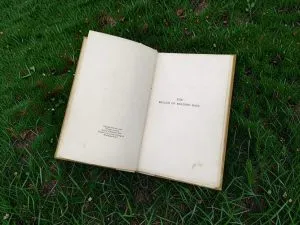
The page pictured above comes from the oldest book in our shop: Poems on Several Occasions, a British poetry collection printed in 1718. Open almost any page and the long s is everywhere, right down to the running header, “Poems on ſeveral Occaſions”. Three hundred years on, it still reads beautifully, which is part of why we love handling books like this.
If you have an old book and you are not sure how old it really is, or whether it is worth anything, we are happy to take a look. Bring it in, or email Rob at [email protected]. You can also browse our rare and antiquarian books to see what else has survived the centuries, and if you are caring for older books, our guide on how to store and care for old books is a good next read.
ZAR |
R |
 |
USD |
$ |
 |
EUR |
€ |
 |
GBP |
£ |
 |
|
ZAR
|
USD
|
EUR
|
GBP
|
See new arrivals first
Join our list for first dibs on rare and collectable finds